COcyber Batch #2 Ambassadors in the Spotlight: Dr. Csaba Krasznay

It’s been a full year since COcyber launched its Ambassador Programme, and with two cohorts now completing their journeys, the network keeps growing stronger. The first ambassadors helped shape the dialogue around Europe’s cybersecurity cooperation, and over the past six months, a second group has carried that momentum forward, connecting new voices, new perspectives, and new countries.
As the second round comes to a close, we look back on the journey of our ambassadors and the insights they’ve shared along the way. In this article, we spoke with Dr. Csaba Krasznay about his work, his perspective on European cybersecurity, and his message as this six-month chapter concludes.
Q: Who are you, and what is your professional background?
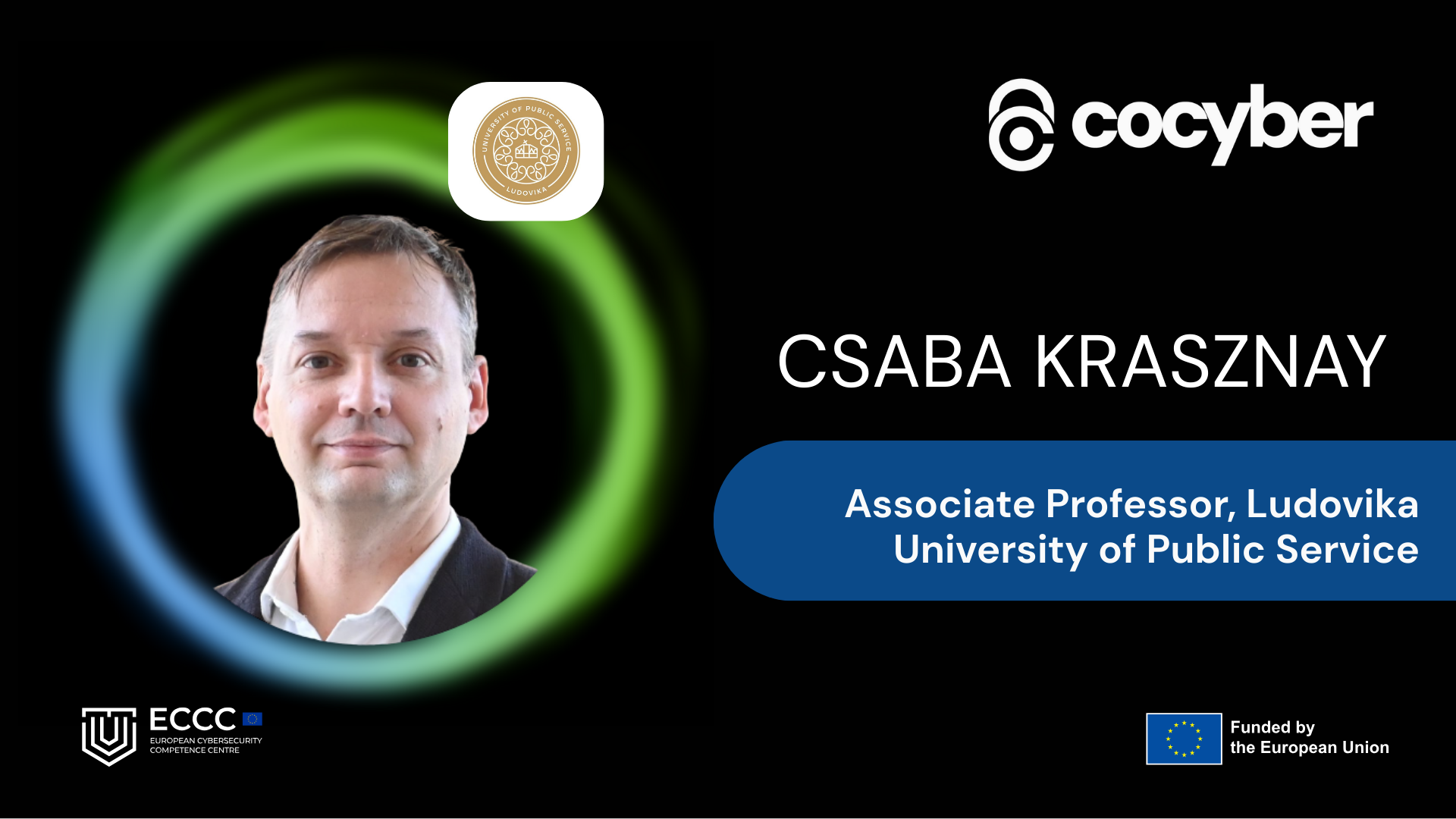
I am an associate professor at the Ludovika University of Public Service, where my research focuses on cybersecurity and cyber warfare. Previously, I served as Head of the Institute of Cybersecurity and currently oversee the Master’s programme in cybersecurity.
I graduated from the Faculty of Electrical Engineering and Informatics of the Budapest University of Technology and Economics in 2003 and earned my PhD in 2012 in military technology sciences. I am also an active lecturer at several European universities and work continuously with both private-sector actors and EU institutions.
In recognition of my contributions, I was voted “Security Expert of the Year” in 2011 and named “Information Security Content Producer of the Year 2025” in Hungary. I am a member of multiple professional organisations, including the ENISA Ad-Hoc Working Group on the European Cybersecurity Skills Framework, and one of the founders of OXO Cybersecurity Lab, a startup incubator supporting innovation in the field.
Beyond academia, I regularly speak at international conferences and contribute to media discussions on cybersecurity. I also volunteer with the International Children’s Safety Service, giving classes to children and parents on safe Internet use.
Q: Since when and how are you involved in the European cybersecurity sector?
My involvement in European cybersecurity began in 2012 through participation in EU-funded project evaluations under Horizon Europe, Digital Europe, and Erasmus+. Over the years, I have coordinated several successful European cybersecurity and education projects.
As a member of the ENISA Ad-Hoc Working Group on the European Cybersecurity Skills Framework, I contribute to shaping European capacity-building policies and act as an ambassador for the framework. I have also represented my country and the academic sector in EU-level conferences at the invitation of the European Commission.
Q: From your perspective, what are the main challenges in the collaboration of the civilian and defence cybersecurity sectors in Europe?
I see five main challenges:
- Information sharing on cybersecurity incidents remains inconsistent, both nationally and across Europe, limiting effective coordination.
- Critical infrastructure protection is often handled by civilian service providers who lack operational links with national defence structures, weakening resilience in crisis or wartime.
- Cyber talent gaps persist between civilian and military domains, as most top experts in the private sector have no formal ties to national defence.
- Adoption of emerging technologies, such as AI in cyber defence, is slow and uneven across Europe, leaving mid-sized nations particularly exposed.
- Limited bilateral and regional cooperation means that lessons learned and good practices are not sufficiently exchanged among Member States.
Q: Again, from your perspective, what are the most crucial steps to address these challenges and strengthen Europe’s joint digital safety efforts?
To address these issues, I see five corresponding objectives:
- Improve Cyber Threat Intelligence (CTI) sharing at national level among military, law enforcement, and civilian Security Operation Centres. This includes reviewing legal barriers for classified information exchange and exploring secure technological solutions.
- Integrate civilian SOCs into wartime defence planning, as critical infrastructures often rely on them for operational protection.
- Enable civilian experts to serve in voluntary cyber defence reserves, providing a legal and organisational pathway for their inclusion in national defence efforts.
- Adopt dual-use technologies, especially AI-enabled cybersecurity tools, more rapidly within defence operations through collaborative R&D and procurement reform.
- Leverage foreign and regional best practices by building structured contact networks among European think tanks to align national cyber capability development with both EU and NATO frameworks.
Q: Did your experience as a COcyber Ambassador align with what you expected at the beginning, and what are your key reflections now that the journey is ending?
Yes, absolutely. From the beginning, I considered the EU call that funded the CoCyber project extremely important, because the gap between the defence sector and the civil sphere is still very real.
As an Ambassador, my goal was to help both sides see the genuine value of closer cooperation. Throughout the programme, this intention was reinforced again and again — both by the overwhelmingly positive reactions I received on LinkedIn to COcyber-related posts, and by the many in-person conversations we had under the COcyber banner during the autumn conference season. Now, looking back, I feel that this journey clearly showed how much potential there is when these two worlds engage more openly and constructively.