COcyber Batch #2 Ambassadors in the Spotlight: Yugo Neumorni

COcyber Batch #2 Ambassadors in the Spotlight: Yugo Neumorni
It's been a full year since COcyber launched its Ambassador Programme, and with two cohorts now completing their journeys, the network keeps growing stronger. The first ambassadors helped shape the dialogue around Europe’s cybersecurity cooperation, and over the past six months, a second group has carried that momentum forward, connecting new voices, new perspectives, and new countries.
As the second round comes to a close, we look back on the journey of our ambassadors and the insights they’ve shared along the way. In this article, we spoke with Yugo Neumorni about his work, his perspective on European cybersecurity, and his message as this six-month chapter concludes.
Q: Who are you, and what is your professional background?
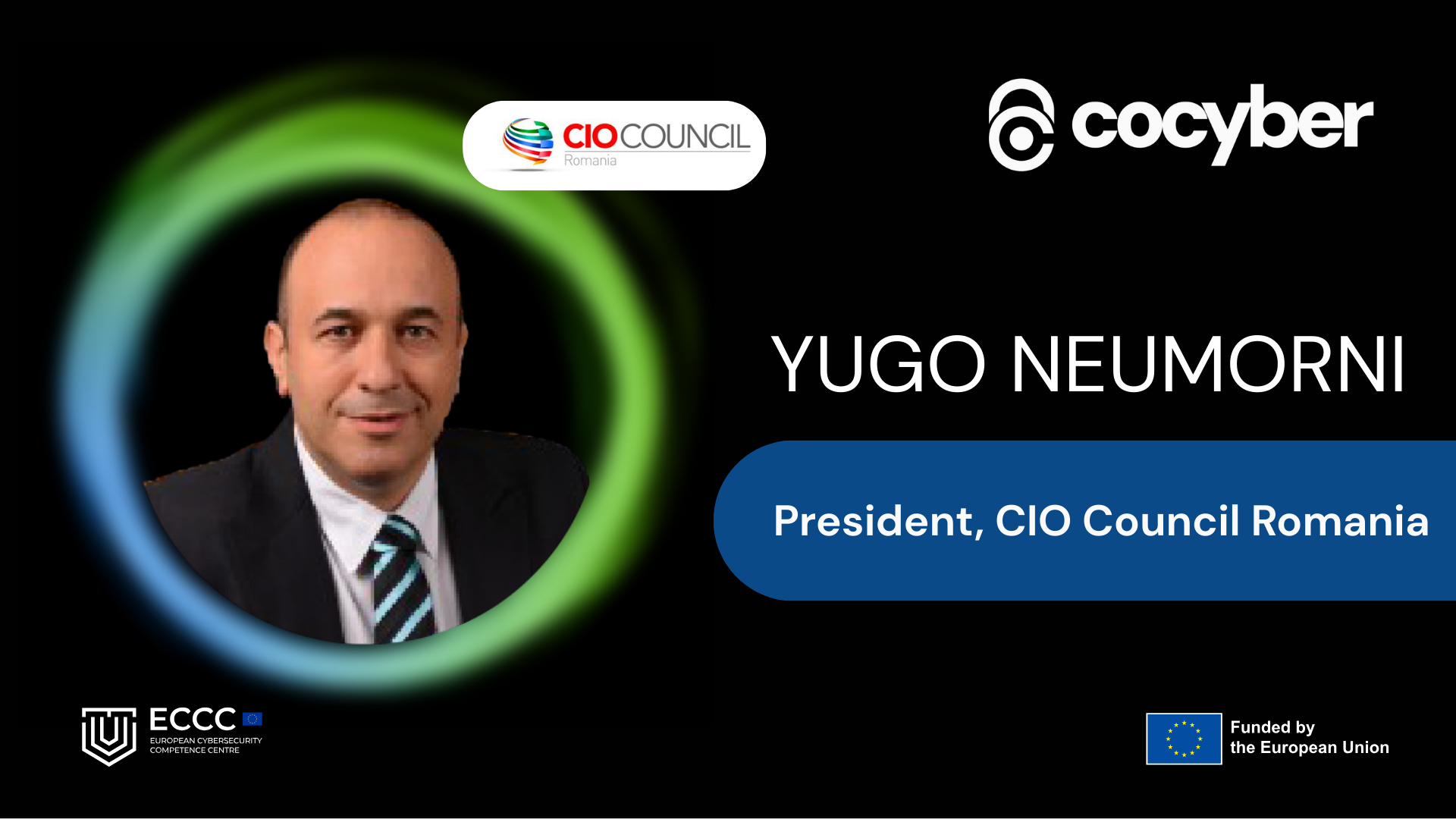
I am the President and co-founding member of CIO Council Romania, the national association representing IT Directors and CIOs. With over thirty years of experience in the IT industry, I have led complex digital transformation initiatives across the energy, manufacturing, and logistics sectors, with a particular focus on cybersecurity and cyber defence, IT governance (COBIT), data privacy, ERP, business intelligence, and IT systems architecture.
Throughout my career, I have worked at the intersection of technology leadership and cybersecurity strategy, ensuring that digital transformation is underpinned by strong governance and resilience principles. My work has consistently sought to strengthen collaboration between the private sector, public institutions, and the broader European cybersecurity ecosystem.
Q: Since when and how are you involved in the European cybersecurity sector?
My involvement in the European cybersecurity sector began in 2018, when I joined the Advisory Board of the Forum International de la Cybersécurité (FIC/InCyber) — one of Europe’s leading platforms for public–private dialogue on cybersecurity. Through this role, I have contributed to shaping discussions on cyber resilience, cross-border cooperation, and emerging technological risks at the European level.
In parallel, I served as Chairman of the European CIO Association, where I led collaborative efforts among CIOs from across Europe to address digital transformation challenges, with cybersecurity at the centre of every resilient digital strategy. In that capacity, I helped bridge dialogue between enterprise IT leaders and European institutions, ensuring that practitioners’ perspectives informed policymaking on digital risk.
At the national level, I remain deeply engaged in Romania’s cybersecurity landscape. I work with local authorities, CERTs, regulators, and industry leaders to promote cybersecurity education, policy development, and capacity-building initiatives. Through events and professional forums, I help bring together business, government, and academia to share knowledge and strengthen Romania’s contribution to European cybersecurity efforts.
Q: From your perspective, what are the main challenges in the collaboration of the civilian and defence cybersecurity sectors in Europe?
Several key challenges make civilian–defence cybersecurity collaboration in Europe complex.
First, legal and regulatory fragmentation remains a major issue. Since defence is largely a national competence, responsibilities and frameworks differ significantly between Member States, complicating cross-border cooperation.
Second, there is a deep cultural divide. Defence institutions operate within strict confidentiality, while the civilian sector - especially private companies and infrastructure operators - values openness and collaboration. This difference in mindset affects trust and information sharing.
Another major challenge involves classified cyber threat intelligence. Defence organisations often hold valuable information that cannot be shared with civilian actors due to security restrictions. This limits situational awareness and preparedness across sectors.
Coordination is further hampered by institutional silos and overlapping mandates. While the defence sector may have advanced capabilities, civilian organisations, particularly in critical infrastructure, often lack comparable resources and expertise.
Lastly, the absence of joint exercises, incompatible procurement procedures, and geopolitical sensitivities (especially around EU and NATO coordination) add to the difficulty of achieving true operational cooperation.
Q: Again, from your perspective, what are the most crucial steps to address these challenges and strengthen Europe’s joint digital safety efforts?
To strengthen Europe’s collective cyber resilience, several strategic steps are necessary:
- Establish a Common Strategic Framework.
Europe needs a coherent cybersecurity strategy that bridges civilian and defence domains, aligning EU-level coordination with NATO frameworks and empowering institutions like ENISA and the European Defence Agency to facilitate joint planning.
- Improve Trust and Information Sharing.
Creating secure platforms for structured intelligence exchange is essential. Shared protocols should balance national security constraints with the need for civilian operators to act on relevant threat data.
- Conduct Joint Training and Simulations.
Institutionalising joint cyber exercises between civilian CERTs, military commands, and private-sector stakeholders will help foster trust and build shared crisis response capacity.
- Invest in Dual-Use Cyber Capabilities.
EU programmes such as Horizon Europe, the Digital Europe Programme, and the European Defence Fund should continue to co-fund innovation in AI-driven detection, quantum-resistant encryption, and secure cloud infrastructure.
- Harmonise Standards and Procurement.
Aligning standards and procurement mechanisms will enhance interoperability and speed up adoption of innovative solutions across both sectors.
- Strengthen Public–Private Partnerships.
The private sector is vital to Europe’s cyber posture. Establishing long-term, legally grounded public–private partnership models will encourage structured cooperation beyond emergency response.
- Promote Cyber Talent Mobility Across Sectors.
Cybersecurity professionals should have career pathways that span civilian, defence, and private domains, supported by joint training initiatives, such as a potential European Cybersecurity Academy.
Taken together, these steps would create a more unified and secure European digital ecosystem, capable of addressing complex threats with both strategic coherence and operational agility.
Q: Did your experience as a COcyber Ambassador align with what you expected at the beginning, and what are your key reflections now that the journey is ending?
Yes, my experience as a COcyber Ambassador fully aligned with—and even exceeded—my expectations. It was a great opportunity to collaborate with COcyber and support its mission to strengthen a robust and inclusive European cybersecurity ecosystem that bridges both civilian and defence sectors. I had the privilege of working closely with fellow ambassadors, exchanging views on Europe’s evolving cyber landscape and contributing to cross-border dialogue.
Throughout this journey, I learned a great deal and I am now bringing this knowledge and experience back to the Romanian business and IT community. The role also allowed me to expand my network, better understand European institutional dynamics, and identify new ways to foster cooperation and awareness at national and regional levels. Overall, it has been an inspiring and valuable experience that I look forward to building upon in the future.