COcyber Batch #3 Ambassadors in the Spotlight: John Soldatos

With its third batch now underway, the COcyber Ambassador Programme continues to expand the network of professionals supporting stronger civilian-defence cybersecurity cooperation in Europe. Since its launch, each of the three cohorts has brought new expertise, perspectives and connections, helping to broaden the project’s outreach and reinforce dialogue within the cybersecurity community.
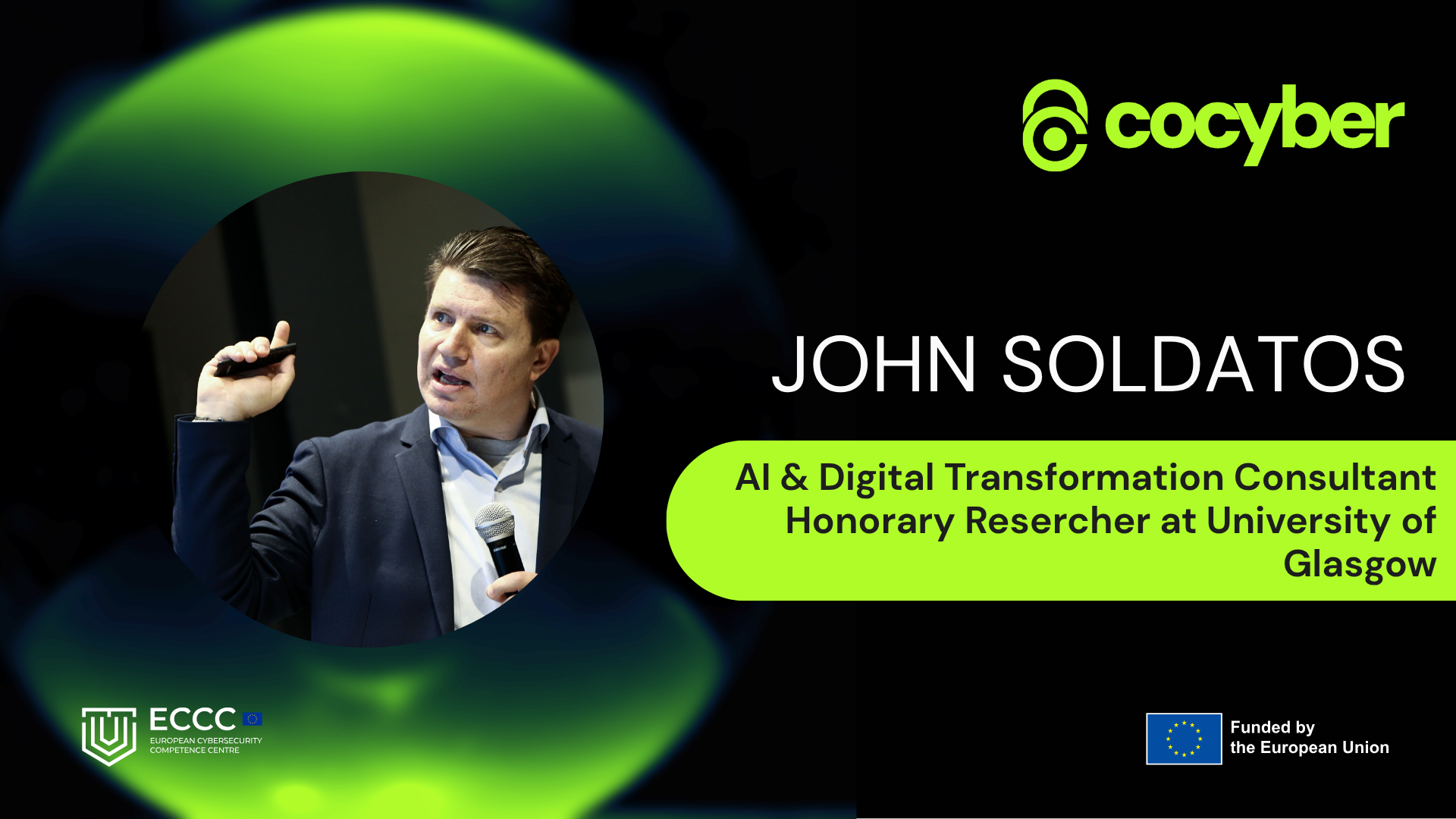
As Batch 3 approaches the final stage of its six-month ambassadorship, we are introducing the professionals who have helped carry this work forward. In this article, we spoke with John Soldatos, AI and Digital Transformation Consultant, Honorary Resercher at University of Glasgow and Scientific Advisor at various enterprises, about his background, his perspective on the European cybersecurity ecosystem, and his reflections on the COcyber Ambassador experience as the journey comes to an end.
Q: Who are you, and what is your professional background?
I hold a PhD in Electrical and Computer Engineering from the National Technical University of Athens and am currently Honorary Research Fellow at the University of Glasgow, a position I have held since 2014. I was previously Associate Professor and Head of the Internet of Things Group at Athens Information Technology, and Adjunct Professor at Carnegie Mellon University in Pittsburgh.
I have significant experience working closely with large multinational industries, including IBM, INTRACOM, INTRASOFT International, and Netcompany, as an R&D consultant and delivery specialist, while also serving as a scientific advisor to high-tech startup enterprises. My areas of expertise span Internet of Things, Artificial Intelligence, and cybersecurity technologies and applications, including applications in smart cities, finance, and Industry 4.0.
I have played a leading role in the successful delivery of more than 80 commercial, research, and business consulting projects for both private and public sector organisations.
I have published more than 200 articles in international journals, books, and conference proceedings, and have co-edited and co-authored ten books on AI, IoT, and cybersecurity themes. I am a regular speaker at international conferences and a contributor to international magazines and blogs on topics related to AI, IoT, Industry 4.0, and cybersecurity.
Q: Since when and how are you involved in the European cybersecurity sector?
I have been involved in the European cybersecurity ecosystem for over 10 years, across research and development, training, capacity building, and community building. Some of the highlights of my involvement include a leading role in the inception and implementation of European R&D projects, as well as the founding and coordination of the European Cluster for Securing Critical Infrastructures (ECSCI), which now counts over 50 EU projects as members.
Within ECSCI, I have also contributed to the field through the editing and authorship of several cybersecurity books, including volumes on cyber-physical threat intelligence for critical infrastructures and security risk management for the Internet of Things, and through the development and delivery of professional training courses and whitepapers on cybersecurity skills for critical infrastructure protection professionals. Most of these books are offered to the community as Open Access volumes and some of them have been downloaded over 100.000 times.
Q: From your perspective, what are the main challenges in the collaboration of the civilian and defence cybersecurity sectors in Europe?
From my perspective, the main challenges are four. The first is solutions and systems fragmentation, the absence of interoperable, integrated approaches across civilian and defence environments.
The second is the skills gap in cybersecurity: the lack of an adequate number of skilled and experienced professionals remains a structural constraint on both sides.
The third is the rising complexity of cyber threats and the increasingly asymmetric environments in which both sectors must operate.
The fourth is the question of sovereignty of cybersecurity solutions, a challenge that cuts across the civilian-defence divide and shapes the conditions under which collaboration is even possible.
Q: Again, from your perspective, what are the most crucial steps to address these challenges and strengthen Europe's joint digital safety efforts?
Three steps stand out as most crucial.
The first is a stronger and more effective collaboration between stakeholders, including trusted sharing of information, without which fragmentation cannot be overcome.
The second is a sustained commitment to education and professional development and training activities for security professionals, to address the skills gap at its source.
The third is closer adherence to and implementation of existing regulations, ensuring that the frameworks Europe has built are actually put into practice rather than remaining on paper.
Q: Did your experience as a COcyber Ambassador align with what you expected at the beginning, and what are your key reflections now that the journey is ending?
My experience as a COcyber Ambassador has clearly exceeded my initial expectations. Honestly, I initially anticipated a structured outreach role in support of the project, yet the ambassadorship evolved into a meaningful opportunity for dialogue on civilian–defence cooperation and cybersecurity capacity building in Europe.
It allowed me to connect my experiences and long-standing work in R&D, skills development and community building with a dynamic network of experts (including Cocyber’s project members) that are committed to similar goals. Specifically, I valued the opportunity to bring perspectives from AI and critical infrastructure security into discussions that spanned various sectors and stakeholder communities.
As the journey comes to an end, I am leaving with a stronger appreciation of how targeted initiatives like COcyber can bridge fragmentation, promote knowledge sharing and foster a shared culture of cyber security and the use of cutting-edge technologies (notably AI) to improve cyber-resilience.
I also carry forward concrete ideas and contacts that will feed into my ongoing work in European cybersecurity projects (e.g., the CyberAID and VIGILANCE projects funded by the European Cybersecurity Competence Centre), as well as my work in the ECSCI cluster. Overall, this ambassadorship has been a rewarding and energizing experience. I really look forward to remaining an active advocate for Europe’s joint cybersecurity and digital safety efforts.