COcyber Batch #2 Ambassadors in the Spotlight: Līga Rozentāle

It’s been a full year since COcyber launched its Ambassador Programme, and with two cohorts now completing their journeys, the network keeps growing stronger. The first ambassadors helped shape the dialogue around Europe’s cybersecurity cooperation, and over the past six months, a second group has carried that momentum forward, connecting new voices, new perspectives, and new countries.
As the second round comes to a close, we look back on the journey of our ambassadors and the insights they’ve shared along the way. In this article, we spoke with Līga Rozentāle about her work, her perspective on European cybersecurity, and her message as this six-month chapter concludes.
Q: Who are you, and what is your professional background?
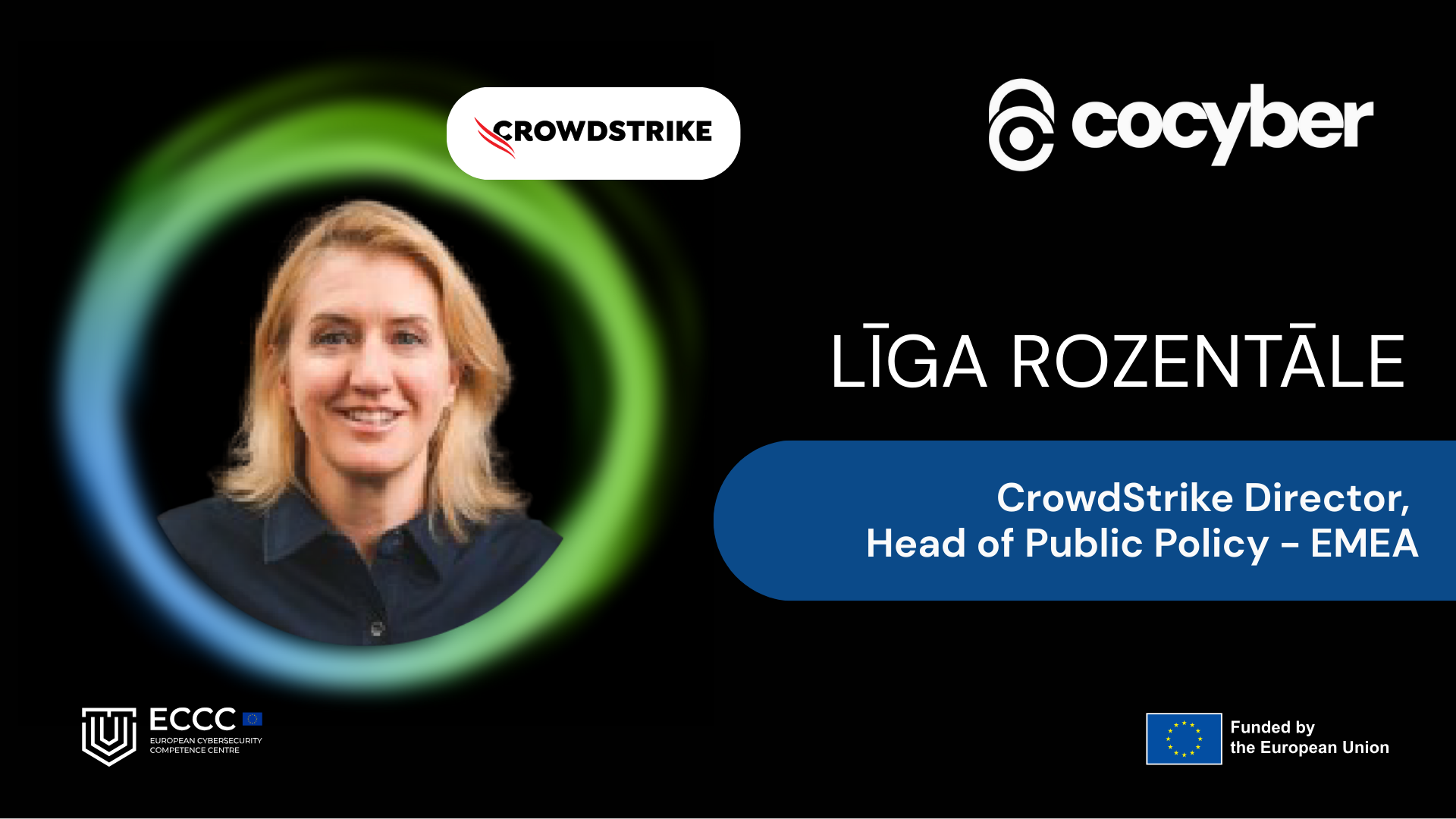
I am a senior leader with over 20 years of experience driving teams on strategic issues for government and business development. Over the course of my career, I’ve worked to foster innovation and thought leadership in cybersecurity and digital policy within the EU, NATO, and UN frameworks.
Currently, I lead Public Policy for EMEA at CrowdStrike, a global cybersecurity company where I focus on advancing dialogue between industry and government on resilience, digital transformation, and security strategy. Before this, I ran my own consultancy advising on digital economy and cybersecurity business development, and earlier served as Senior Director for Microsoft European Government Affairs (Cyber & Defence).
My career began in nonproliferation research, building on graduate studies in conflict negotiation and international policy in defence and security, but quickly moved to civil service in the Ministry of Defence of Latvia focusing on bilateral and multilateral relations. After over a decade of national service, I shifted to diplomacy, as Latvia’s first cyber diplomat, representing my country at the EU, NATO, and the UN. That role was at the very dawn of cyber diplomacy, when Europe was first defining its position in what has become the fifth domain of warfare.
Recognised among the top 50 most influential women in European cybersecurity, I also serve on advisory committees and boards for the European Commission, ENISA, Women4Cyber, EU Navigator, COCyber, and the Global Cyber Alliance.
Q: Since when and how are you involved in the European cybersecurity sector?
I have been engaged in the European cybersecurity sector since the early 2000s, when cyber diplomacy itself was an emerging field. As Latvia’s first cyber diplomat, I helped shape Europe’s initial approach to cybersecurity, balancing defence considerations with the need for shared situational awareness, a common horizontal European legislative frameworks and international coordination.
In the private sector, my roles have focused on connecting leading technology companies to European and EMEA governments and institutions to foster AI development, cyber resilience, public–private partnerships, and innovation. At Microsoft, I led a team on cyber and defence policy. Later, as an independent consultant, I advised clients across Europe on cybersecurity and the digital economy.
Today, at CrowdStrike, my work continues to bridge the public and private domains by developing policy dialogue on the future of AI, cybersecurity, resilience, and critical infrastructure protection- in both the civilian and defence environment.
Alongside my professional responsibilities, I remain active in European and global advisory networks, contributing to initiatives by the Europen Commission, ENISA, Women4Cyber, EU Navigator, and the Global Cyber Alliance, each committed to strengthening Europe’s capacity to anticipate, prevent, and respond to cyber threats.
Q: From your perspective, what are the main challenges in the collaboration of the civilian and defence cybersecurity sectors in Europe?
Cybersecurity has no clear boundaries. State actors, criminals, and hybrid threats exploit vulnerabilities that touch every layer of society, from critical infrastructure to economic and social stability. Attacks range from isolated criminal incidents to full-scale warfare, making cooperation between civilian and defence sectors essential yet inherently difficult.
The main challenge is that national security priorities and European cybersecurity regulation often operate in parallel rather than in tandem. While defence structures are driven by classified operations and strategic secrecy, civilian cybersecurity initiatives emphasise openness, regulation, and standardisation. These parallel tracks rarely intersect, leading to visibility gaps, duplicated efforts, and missed opportunities for coordination.
The key lies in achieving greater mutual visibility, ensuring both sectors understand each other’s structures, needs, and objectives so that Europe’s cybersecurity architecture functions as one ecosystem rather than two.
Q: Again, from your perspective, what are the most crucial steps to address these challenges and strengthen Europe’s joint digital safety efforts?
The defence and military sectors should be integrated, as is possible, into Europe’s broader cybersecurity ecosystem, alongside domains like finance, energy, and manufacturing.
While the military will always operate under its own protocols, incorporating military considerations into European cybersecurity standards and incident reporting structures would build familiarity and alignment between civilian and defence actors.
Such integration would enhance preparedness while also fostering shared understanding across all sectors, improving coordination in both policy and operational responses. Strengthening trust depends on sustained, structured collaboration that integrates crisis response with routine cybersecurity management and resilience planning.
Q: Did your experience as a COcyber Ambassador align with what you expected at the beginning, and what are your key reflections now that the journey is ending?
Yes, but the role proved more complex than I initially anticipated. When I established my roots in cybersecurity, the civilian–military divide was challenging but navigable; today, bridging that gap is significantly harder. Civilian regulatory, strategic, and operational cooperation has expanded exponentially, with cybersecurity now integrated horizontally across economic, security, and privacy domains.
On both the EU and NATO fronts, keeping sight of the full picture has become increasingly difficult. My key reflection is that defence must be treated as critical infrastructure from the outset of all new or revised initiatives, to ensure it is fully integrated into the rapidly evolving cybersecurity ecosystem.